ICC World Cup New Format has been officially approved, marking one of the biggest structural overhauls in the history of international cricket. The International Cricket Council (ICC) has introduced sweeping changes to the formats of both the ICC Men’s ODI World Cup and the ICC Men’s T20 World Cup, aiming to make every game more competitive and meaningful from the opening fixture to the final.
The decisions were approved during the ICC Board‘s annual meeting in Edinburgh after recommendations from the Chief Executives’ Committee. The governing body believes the revised tournament structures will reduce dead rubbers, create more high-pressure contests, and provide greater opportunities for emerging cricket nations to compete against the world’s leading teams.
Alongside the new tournament formats, the ICC also approved a revised qualification pathway for the 2028 Men’s T20 World Cup and gave initial approval to a new global T20 competition for Associate Member nations.
Why the ICC Is Changing the World Cup Format
One of the biggest criticisms of previous ICC tournaments has been that several group-stage matches had little impact on qualification. Once teams were either safely through or mathematically eliminated, many fixtures became little more than formalities.
With the ICC World Cup New Format, the governing body wants to ensure that nearly every match has direct consequences for qualification. According to the ICC, the objective is to increase competitiveness throughout the tournament while maintaining excitement for players, broadcasters, and cricket fans.
The revised structure is designed to reward consistency across multiple stages instead of allowing teams to recover from poor starts with relatively easy fixtures later in the tournament.
ODI World Cup to Retain 14 Teams but Adopt a Three-Stage Format
Although the number of participating teams in the Men’s ODI World Cup will remain at 14, the tournament structure will change significantly.
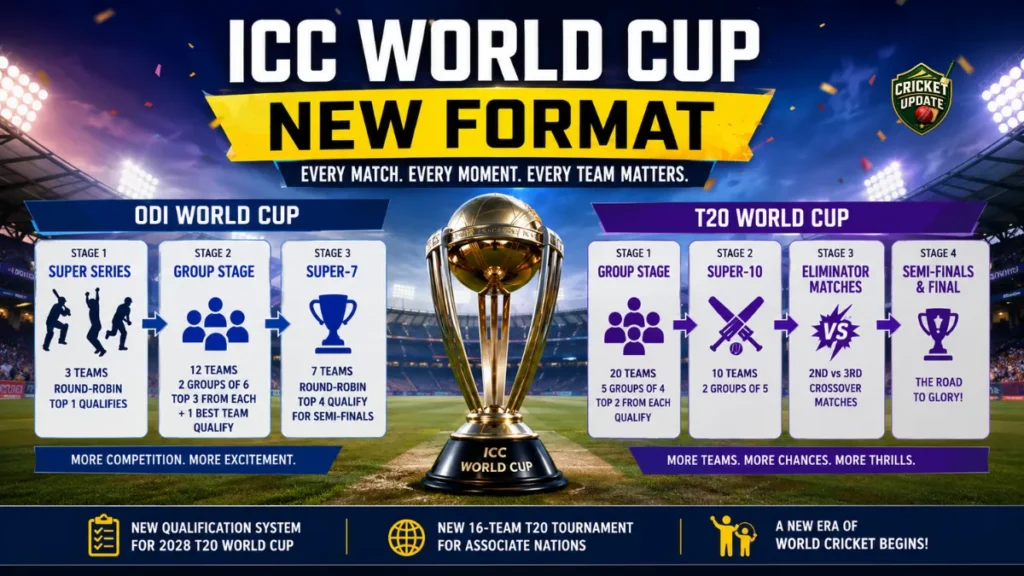
Instead of beginning immediately with the main group stage, the competition will now feature three distinct phases.
Stage One: Super Series
The opening phase, known as the Super Series, introduces an entirely new concept.
The teams ranked 12th, 13th, and 14th in the ICC rankings will compete in a round-robin contest before the main tournament begins. Each team will play against the other two, with only the highest-ranked side advancing.
The remaining two teams will be eliminated before the group stage starts.
This means the tournament begins with high-stakes cricket, where every result could determine whether a team stays alive or exits the competition.
Rather than easing into the World Cup, lower-ranked teams will immediately face knockout-like pressure.
Stage Two: Group Stage
Once the Super Series concludes, the main tournament begins with 12 teams.
These teams will be divided into two groups of six.
Each side will compete against the other teams within its group, with qualification determined by overall performance.
The progression system works as follows:
The top three teams from each group qualify automatically.
One additional team with the next-best overall performance also advances.
That creates a total of seven teams progressing to the next phase.
The format places considerable importance on every group-stage fixture because finishing positions could determine whether a team advances directly or misses out altogether.
Stage Three: Super-7
Perhaps the most significant innovation in the ICC World Cup New Format is the introduction of the Super-7 stage.
Instead of the previous Super Six system used in earlier editions of the ODI World Cup, seven qualified teams will compete against one another in another round-robin league.
Every team will face each of the other six teams, making consistency essential over multiple matches.
At the end of this stage:
The top four teams qualify for the semi-finals.
First plays fourth.
Second plays third.
The two winners advance to the World Cup Final.
Because qualification remains open until the closing rounds of the Super-7, the ICC expects far fewer meaningless matches than in previous tournaments.
How the New ODI World Cup Differs from Earlier Formats
Earlier editions featuring 14 teams generally divided participants into two groups of seven.
The top three teams from each group advanced into a Super Six stage before the knockout rounds.
The new structure replaces the Super Six with the Super-7 while introducing the qualifying Super Series before the group stage.
The result is a tournament in which qualification pressure begins much earlier and remains throughout every stage.
For teams ranked outside the world’s elite, simply reaching the main draw now requires surviving an additional competitive phase.
T20 World Cup Also Receives a Major Overhaul
The ICC has not limited its reforms to the 50-over format.
The Men’s T20 World Cup will also operate under a redesigned structure aimed at giving more teams meaningful opportunities later in the competition.
The decision follows several impressive performances by emerging cricket nations in recent ICC tournaments, highlighting the growing competitiveness of Associate and developing cricket nations.
Five Groups Replace Four
Previously, the T20 World Cup featured:
Four groups
Five teams in each group
Under the new system, the tournament will instead feature:
Five groups
Four teams in each group
The top two teams from every group will qualify for the second phase.
That means 10 teams will move forward instead of eight.
The revised group distribution also allows for a more balanced schedule while expanding the number of teams competing beyond the opening round.
Super-10 Replaces Super-8
The second stage will now become the Super-10, replacing the previous Super Eight format.
The 10 qualified teams will be split into:
Two groups of five teams each.
Teams will once again compete within their respective groups, with qualification for the semi-finals determined through a combination of direct advancement and eliminator matches.
The larger second stage gives more nations additional matches against high-quality opposition while reducing the chances of early elimination after a single poor performance.
Eliminator Matches Add Knockout Drama
One of the most exciting features of the revised T20 World Cup is the introduction of Eliminator matches.
Instead of only the top two teams from each group progressing directly, qualification will work differently.
The group winners will qualify automatically for the semi-finals.
The remaining two semi-final places will be decided through crossover Eliminators:
The second-placed team from one group faces the third-placed team from the opposite group.
The second-placed team from the other group plays the third-placed side from the first group.
The winners of these matches complete the final four.
This format ensures that teams finishing third still have a realistic chance of reaching the knockout rounds, keeping qualification battles alive until the final round of Super-10 fixtures.
New Qualification System for the 2028 T20 World Cup
The ICC Board also approved a revised qualification pathway for the 2028 Men’s T20 World Cup.
The new system seeks to create a clearer route for Full Members and Associate nations while rewarding strong performances in previous tournaments.
Among the key changes:
Scotland will receive direct entry into the European Regional Final based on specific qualification criteria.
Teams participating in the 2026 T20 World Cup that fail to secure automatic qualification for 2028 will receive places in the Global Qualifier.
The remaining qualification spots will be allocated through regional qualifying tournaments across Africa, Asia, Europe, the Americas, and East Asia-Pacific.
Regional representation will continue to play a central role in ensuring worldwide participation.
The final World Cup qualification places will be awarded to regional winners along with the highest-performing remaining teams under ICC qualification standards.
New Global Tournament Planned for Associate Nations
Beyond changes to the World Cup itself, the ICC has also taken another step toward strengthening cricket outside the traditional powerhouses.
The Board has given in-principle approval for a new 16-team global T20 tournament exclusively for Associate Member nations.
The competition is expected to be staged before the main T20 World Cup.
Its purpose is to provide smaller cricket nations with more high-quality international fixtures and valuable tournament experience before competing on cricket’s biggest stage.
However, the proposal still requires final financial and commercial approval before becoming part of the official ICC calendar.
What These Changes Mean for International Cricket
The ICC World Cup New Format represents more than just a change in scheduling.
It reflects the ICC’s broader strategy to improve the competitive balance of international tournaments.
Several objectives stand out:
Reduce low-stakes matches.
Increase competitive intensity throughout every stage.
Reward consistency over multiple rounds.
Create more meaningful opportunities for emerging nations.
Deliver stronger television and fan engagement.
Modern international cricket has become increasingly competitive, with Associate nations regularly challenging Full Members in global events.
By expanding later tournament stages and introducing additional qualification opportunities, the ICC hopes to accelerate that trend while maintaining the prestige of the World Cup.
Greater Opportunities for Emerging Teams
In recent years, teams outside cricket’s traditional elite have produced memorable performances on the global stage.
Upsets against established Test-playing nations have demonstrated that the gap between leading countries and emerging teams continues to narrow.
The revised structures acknowledge this shift by ensuring that developing teams receive:
More matches against elite opposition.
Greater opportunities to qualify for later rounds.
Increased exposure on the international stage.
Valuable experience in high-pressure tournament cricket.
This could contribute significantly to the long-term development of cricket in newer markets.
Fans Can Expect More High-Stakes Cricket
For supporters, one of the biggest advantages of the ICC World Cup New Format is that almost every fixture carries greater importance.
Instead of waiting until the knockout rounds for must-win encounters, teams will face pressure from the very beginning.
The Super Series, Super-7, Super-10, and Eliminator matches all introduce scenarios where qualification depends directly on individual performances rather than simply accumulating enough points in lengthy group stages.
The revised structure is expected to create more dramatic finishes, tighter qualification races, and increased uncertainty throughout both tournaments.
A New Era for ICC World Cups
The ICC‘s latest reforms represent one of the most ambitious tournament redesigns in modern cricket.
While the number of participating teams remains largely unchanged, the path to lifting the World Cup trophy will become significantly more demanding.
The introduction of the Super Series in the ODI World Cup, the Super-7 stage, the expanded Super-10 in the T20 World Cup, crossover Eliminators, a revamped qualification pathway, and a proposed tournament for Associate nations all point toward a more competitive global cricket landscape.
Whether these changes ultimately deliver the excitement the ICC hopes for will only become clear once the formats are implemented. However, one thing appears certain: under the ICC World Cup New Format, every match is expected to matter far more than before, ensuring that future ICC tournaments feature higher stakes from the opening ball to the championship final.